

3rd Sacred Music Festival, First Evangelical Church of Athens, April 14th.
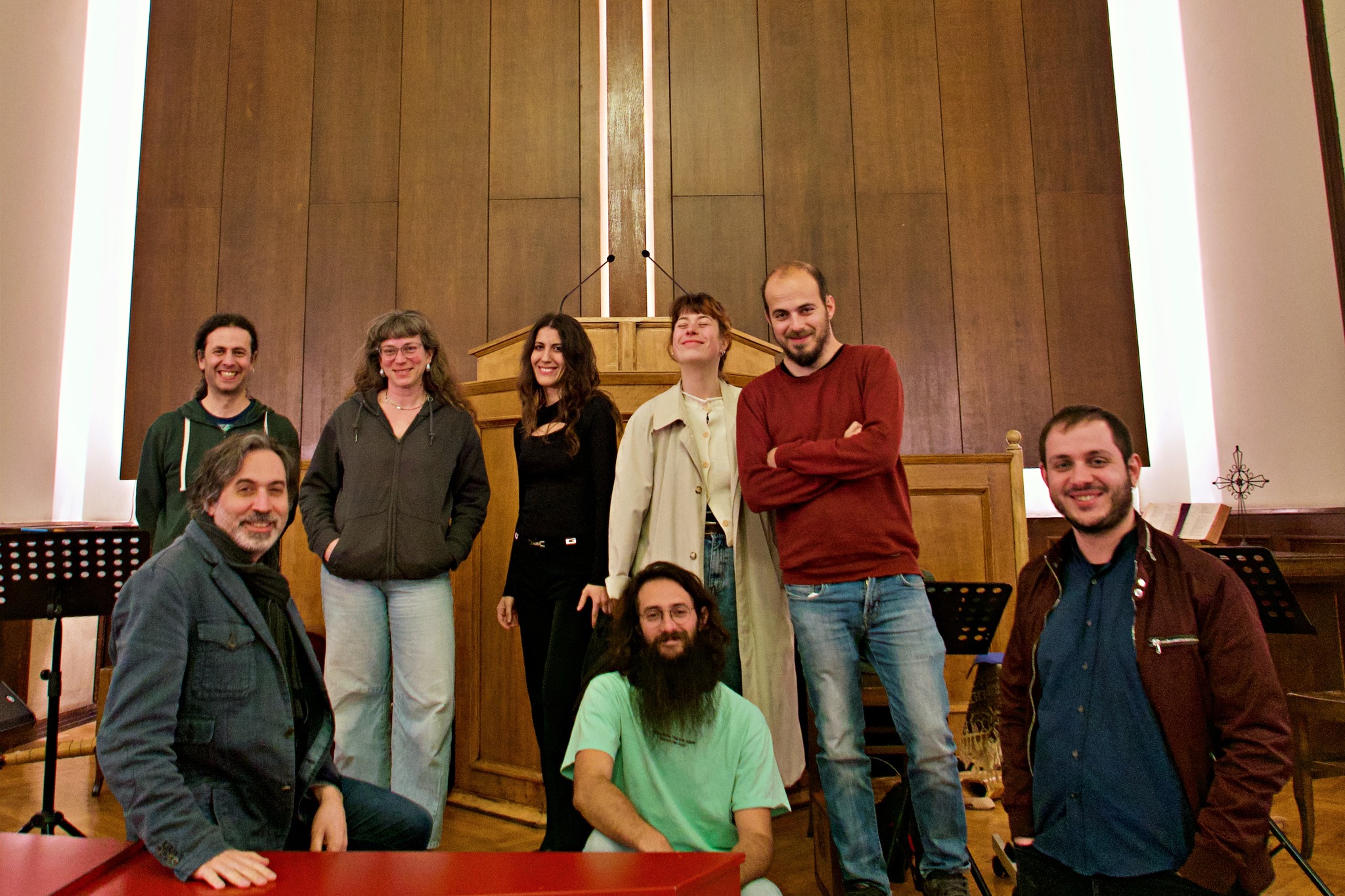
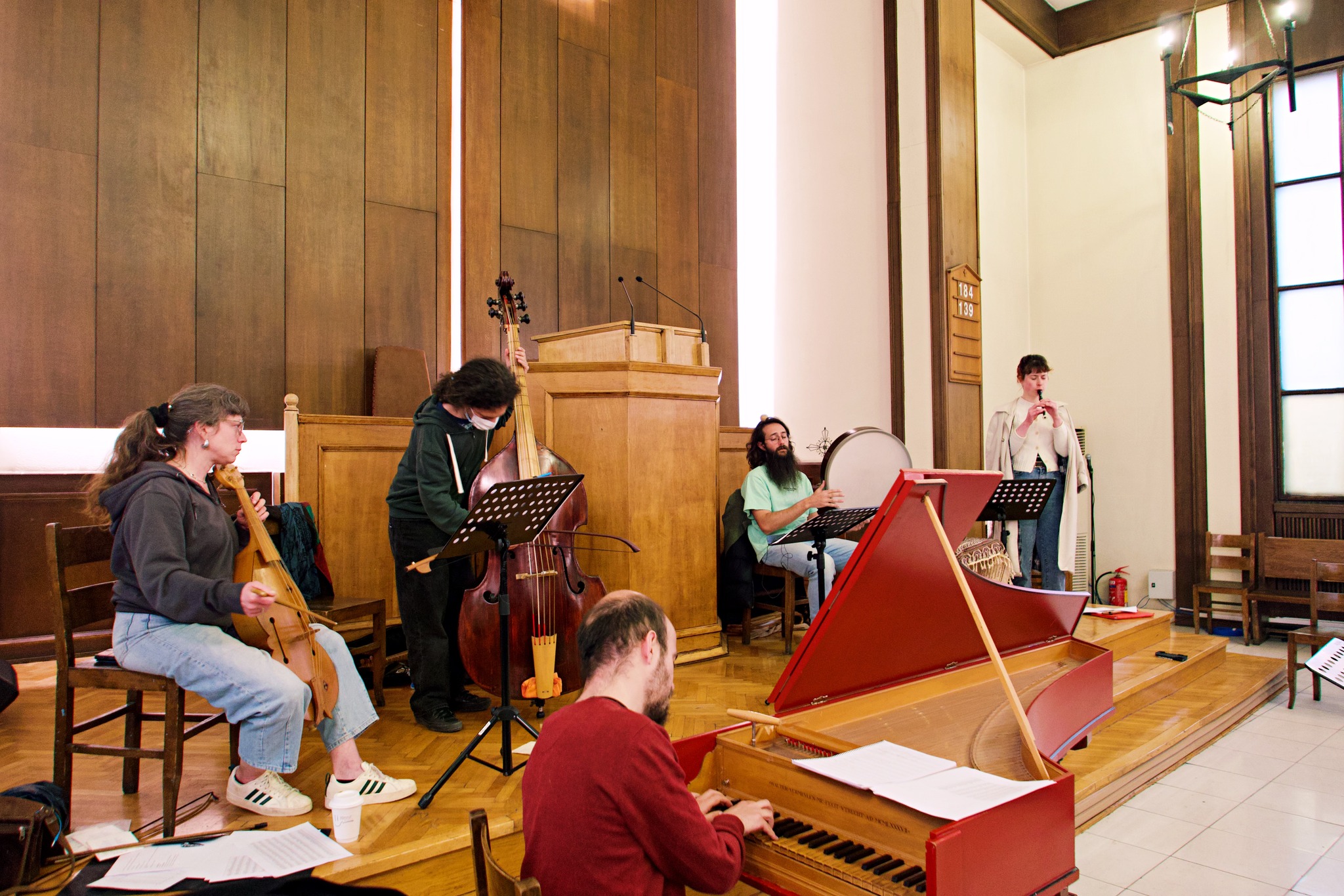
As part of the 3rd Sacred Music Festival of the Greek National Opera, our ensemble collaborated with renowned composers and early music specialists from Greece for the new project Nature, Worship, and the Divine (Φύση, Λατρεία και Θείο).
It is a dream to realise this unique performance in the land of the Sibyls (Σίβυλλαι), the ancient voices that inspire our name and mission. Collaborating with contemporary composers brought a new dimension to our ensemble’s work. We became co-creators of new music that draws from medieval aesthetics and compositional techniques, while exploring unorthodox techniques on historical instruments.
We are also very grateful to work with Greek musicians: Elektra Miliadou (medieval vielle, viola da gamba), Dimitris Tigas (medieval vielle, violone), Alex Mastichiadis (harpsichord, organ).
Warmest thanks to the GNO, the people from the church, and everyone involved for sharing our vision.
Nature, Worship, and the Divine
With a strong element of the Divine, human passion, and the need for transcendence, a musical performance is created with medieval and contemporary music on historical instruments, drawing inspiration from the relationship between nature and the Divine as depicted in Western and Eastern medieval musical traditions. The concert, with works that celebrate nature from the recent Sibil•la Ensemble album, titled Viriditas, connects world premieres with the homonymous medieval concept that symbolizes the beginning of life, the eternal life-giving energy and the divine element that encompasses every form of life, including humans. The works created by Yannis Kyriakides, Ioannis Panagiotou, and Aggelos Mastrantonis were commissioned by the ensemble in collaboration with the GNO, while the work of Aspasia Nasopoulou was adapted for the ensemble.
This musical gathering redefines the allegory of Nature, Worship, and the Divine, blending the present with the past and launching a new kind of ceremony through the art of sound.
Programme
Hildegard von Bingen (1098-1179): O virtus Sapientiae
Ioannis Panagiotou (b. 1995): Apíchima (world premiere)
Misteri d’Elx chant: O Arbre Sanct
*Aggelos Mastrantonis (b. 1990): Comin’ Thro’ the Rye (world premiere)
Aspasia Nasopoulou (b. 1972): Plenitude (Greek premiere)
Byzantine folk song of Cyprus: Parakalo tin Panaya / Pray to the Virgin Mary [Παρακαλώ την Παναγιά]
*Yannis Kyriakides (b. 1969): Lingua Ignota (world premiere)
Hildegard von Bingen (1098-1179): Karitas Habundat

Programme Notes
Worship has always been inextricably linked to nature. According to medieval theorists, nature is a medium through which humans can observe signs of divine power, intelligence, and beauty. Nature’s elements reflect the strength of God, and profound wisdom can be drawn from them, allowing us to experience the ecstasy of creation through our three parts: soul, body, and senses. Studying them is an exploration of divine mysteries, and the natural world becomes a sacred space that people can potentially experience.
Hildegard von Bingen’s hymn O virtus Sapientiae, dedicated to the allegory of Wisdom, is translated as:
“O power of Wisdom, whirling you encircle, comprehending everything in one path possessed of life, Three wings you have, of which one soars into heights, and the other sweeps the earth, and the third flies all around. Praise be to you, as is your due, O Wisdom.“
Connecting Western and Byzantine traditions, Ioannis Panagiotou’s new work Apíchima explores the poetry of Abū Firās and Abd al-Wahhab Al-Bayati. Nature becomes both witness and recipient of the suffering of captivity and exile, as well as a vehicle for the search for divine presence. The piece is based on a set of apechimata (intonation formulas) from Byzantine music, which are refracted and transformed, creating new tunings and timbres.
The medieval vespers chant O Arbre Sanct (“O Holy Tree”) comes from El Misteri d’Elx, a liturgical drama on the death and Assumption of the Virgin Mary, still performed in the city of Elche, Spain. The tree symbolizes the Cross and becomes a sign of Christ’s greatest sacrifice and Resurrection—his victory over human mortality.
“O Holy Tree, Worthy of Honour, as you are the most precious of all,
on you He wanted to bathe with blood, the One who wanted to save the world.“
Aggelos Mastrantonis sets to music the poem Comin’ Thro’ the Rye by Robert Burns (1759–1796), revealing the complex interplay between desire, social norms, and the fleeting nature of human connection. Historically, the song is linked to the oral tradition of secular love songs, in which nature often served as a sacred refuge and silent witness to human longing. Just as medieval rituals often mingled the sacred with the sensual, the piece explores the threshold between personal desire and collective experience.
Aspasia Nasopoulou’s piece Plenitude (2019) draws inspiration from the Rubaiyat poems of the Persian mathematician and philosopher Omar Khayyám (1048–1131). The Arabic verses reflect how true prosperity is not found in material wealth and grandeur, but in the simplicity of existence, in silence, and in communion with the world around us:
“I need a jug of wine and a book of poetry, half a loaf for a bite to eat, then you and I, seated in a deserted spot will have more health than a Sultan’s realm.”
In the Byzantine Cypriot secular song Parakalo tin Panagia (I worship the Virgin Mary), the dreamlike landscape of Cypriot orchards evokes the Garden of Eden, where everything blooms, and simultaneously recalls the Western medieval notion of the Hortus Conclusus (enclosed garden), where the Virgin’s innocence is protected. The Cypriot dialect, dating back to around 1400 BCE, resounds:
I worship the Virgin Mary, and worship Constantinople, to grant me the keys
to enter the garden.
In his homonymous new work, Yannis Kyriakides revives the Lingua Ignota (Unknown Language), the mystical language invented by Hildegard von Bingen, and translates it into music through various algorithms. The Lingua Ignota is one of the earliest known constructed languages, with 23 letters and a glossary of 1,011 words. Each word, corresponding to theological and spiritual concepts, generates contrapuntal melodies.
“Love abounds in all, from the depths exalted and excelling over every star, and most beloved of all, for to the highest King she gave the kiss of peace.
(Karitas Habundat, Hildegard von Bingen)


 Sibil•la Ensemble
Leave a comment