
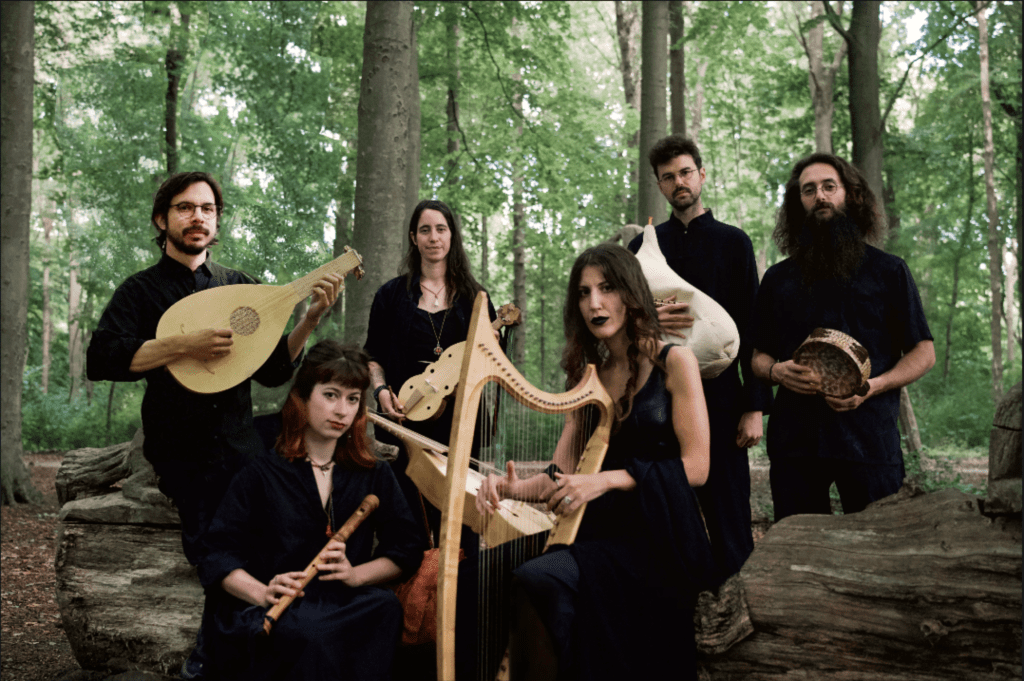
Welke muziek galmde door de straten, in kerken, kroegen en houten huizen van vroeg Amsterdam? We vroegen het Ensemble in residence Sibil•la. Onder de gewelven van de Vondelkerk, plaatsen de musici oude Amsterdamse muziek in het perspectief van het culturele landschap van nu. Doedelzak, draailier en slagwerk brengen de stad van toen tot leven.
Huib Ramaer, Muze van Zuid
Celebrating 750 years of ‘Amestelledamme’, we created a new concert program called Echo’s van Holland and performed it in the beautiful Vondelkerk on September 13th, as part of the Muze van Zuid festival in Amsterdam.
Echo’s van Holland was a centerpiece of our residency with Muze van Zuid and was commissioned by the festival’s director Huib Ramaer, with whom we had a close and wonderful collaboration. This project gave us the opportunity to reimagine the musical life of Amsterdam from its early days to the present, and make audible what once might have echoed in wooden houses, churches, taverns, and streets of a growing city.
Kristia Michael voice
Coline Kreis medieval vielle
Marguerite Maire recorders
Jeremy Bass medieval lute
Sanne van Gend hurdy-gurdy
Giuseppe Doronzo bagpipe, xaphoon, hulusi, longar double flute
Ivan Gianakis percussion
Many thanks to Concertzender for recording the concert and to Muze van Zuid for the video material!
Het Sibil•la Ensemble roept het leven op van middeleeuws en renaissancistisch Nederland, met speciale aandacht voor de stad Amsterdam. De musici bespelen kopieën van oude instrumenten, vaak nog in gebruik te zien op doeken van meesters als Frans Hals. Nieuwe geluiden en experimentele technieken weerspiegelen de evoluerende geschiedenis van de stad en de multiculturele uitwisseling en invloeden, die Amsterdam en haar omgeving van 1275 tot nu tot bloei brachten en brengen. Een muzikaal spel met onze verbeelding!
Huib Ramaer, Muze van Zuid

From Amestelledamme to Amsterdam
Since the 13th century, the small settlement in the Amstel delta was already known as ‘Amestelledamme,’ or ‘Amstelredam‘, later ‘Aemsterdam’ and ‘Amsterdam‘), literally meaning ‘people who have settled at the dike along the river.’ There are records referring to a dam and sluice structure dating from 1275, which is commonly celebrated as the city’s founding milestone. Over the centuries, Amsterdam grew from a riverside settlement to an important medieval town, then a centre of trade, culture, maritime power, and innovation.
By the 15th and 16th centuries, Amsterdam was already playing an important role in the Low Countries’ arts and literature. The city’s religious institutions, guilds, trading links, and regional connections meant that musical life, such as liturgical chants, secular songs and dances, would have been part of daily experience.
Through the Renaissance, the Reformation, the Golden Age, and onward, Amsterdam absorbed influences from Flanders, Germany, Italy, France, and beyond. The city’s pluralism and mercantile openness made it a crossroads of ideas and cultures.
By 2025, Amsterdam celebrates 750 years since that foundational date of 1275, and Echo’s van Holland is our tribute, a musical landscape through those centuries, from medieval to contemporary, celebrating the rich and multicultural heritage of the city.

Concert Program
In Echo’s van Holland, our vision is to create a living conversation of early voices and modern ones, entwined. The program brings together medieval, renaissance, and new music of the Netherlands into dialogue, conjuring the sound world of Amsterdam as a vibrant continuum – a city where innovation, tradition, and diversity always resonate side by side.
In this program, we highlight under-heard early repertoire alongside new works, sharing new dimensions of history and sound: from the mystical verses of Hadewijch van Brabant and the rich polyphony of Christian Hollander and Carolus Souliaert, to secular monophonic songs from the Gruuthuuse manuscript and Dutch folk melodies. To bridge past and present, we perform music by Dutch and Amsterdam-based composers Louis Andriessen, Yannis Kyriakides and Amarante Nat.
Hadewijch van Brabant ca. 1200 – ca.1260: Namelike ghi ende ic
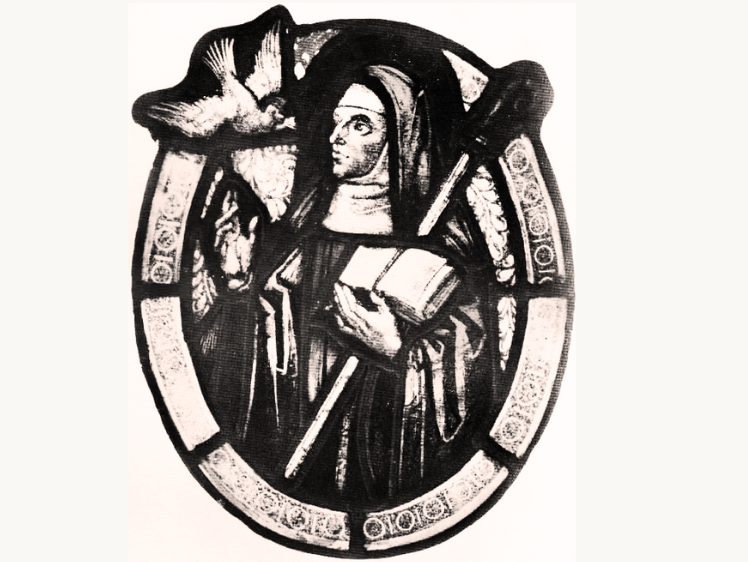
Inspired by the writings of Dutch mystic, poet, and visionary Hadewijch van Brabant, whose writings are among the earliest and most powerful works in Middle Dutch, our ensemble members Kristia Michael and Marguerite Maire composed the chant Namelike ghi ende ic.
Likely a beguine, she combined courtly love with mystical theology, expressing her Union with the Divine in passionate poems, visions, and letters. Hadewijch’s works had a lasting influence on later mystics in the Low Countries, and today she is considered one of the great voices of medieval European spirituality.
| Namelike ghi ende ic, die noch niet worden en sijn dat wi sijn ende noch niet vercreghen en hebben dat wi hebben; Ende dien noch soe verre sijn dat onse es, wi behoeven sonder sparen al omme al te darvene ende enichlike ende ghenendichleke te leerne dat volmaecte leven der minnen, die ons beiden beruert hevet te haren werke. | Namely you and I – we who still have not become what we are, who still have not acquired what we have; who still are so far away from what is ours, we have to let go everything without reservation and exclusively, fearlessly learn the perfect life of the love, that has stirred both of us to her Labour. |
Gruuthuuse manuscript 14th century
The Gruuthuuse Codex, compiled in late 14th and early 15th century Bruges, is one of the most remarkable manuscripts of the medieval Low Countries. It preserves more than 200 Middle Dutch songs, poems, and prayers, along with rare musical notation, that reveal the intertwined aspects of love, devotion, and urban culture in Dutch medieval society.
As one of the earliest collections of Dutch song with melodies, the codex is a treasure for both scholars and performers. We have researched the manuscript and transcribed two secular songs: Sceiden, onverwinlic leit (‘Separation, unbearable suffering’), Egidius waer bestu bleven (‘Egidius, where have you been’), Aloeette vogel clein (‘Lark, Little Bird’).

Oude en Nieuwe Hollantse Boerenlieties en Contredansen (1700–1716)
‘Old and New Dutch Peasant Songs and Country Dances’ preserves popular songs, instrumental pieces, and contredanses that circulated widely among both rural and urban communities of the Netherlands. The collection offers insights into the social and musical life of the Netherlands at the time, illustrating the interplay between vernacular traditions and formalized musical practice. We perform the pieces: Ik ging een vreyen tot Amsterdam, De naem was Titata.
Contemporary Music of the Netherlands
Since the mid-20th century, the Netherlands has played a central role in the development of contemporary music in Europe. The country’s strong tradition of supporting the arts, its international orientation, and its openness to experimentation have made it a blooming ground for composers and performers.
At the heart of this landscape is the Composition Department of the Royal Conservatory of The Hague (Koninklijk Conservatorium). Founded in 1826 and internationally renowned for its innovative pedagogy, the conservatory has nurtured generations of composers who continue to shape the international contemporary music scene. Alumni and faculty, including Louis Andriessen and Yannis Kyriakides have defined much of the Netherlands’ avant-garde identity.
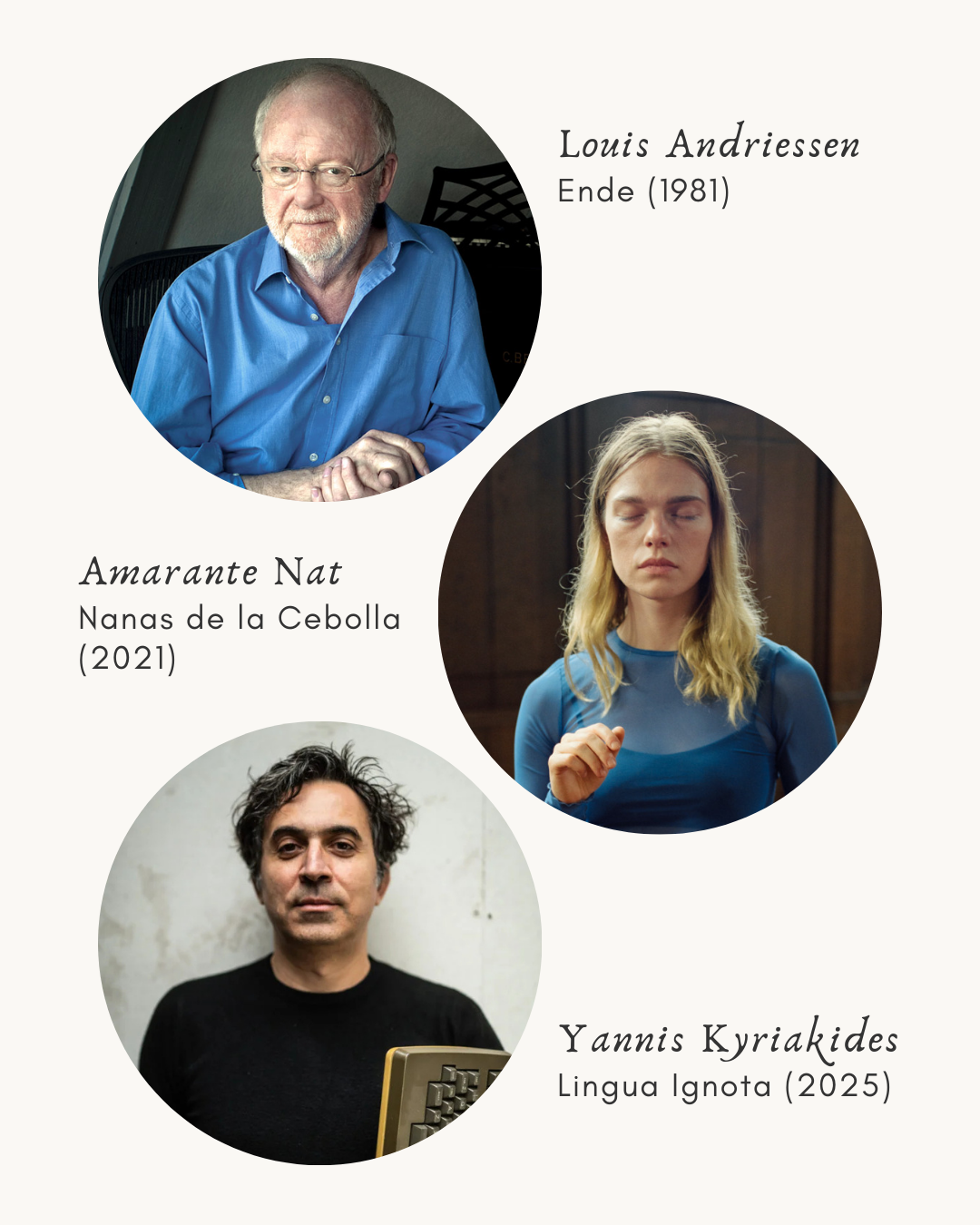
In Echo’s van Holland, we perform contemporary music by three generations of composers:
Louis Andriessen: Ende (1981) for two recorders and one performer.
Louis Andriessen is regarded as the leading Dutch composer of his generation, with a legacy that transformed the global new music scene.
Ende, originally composed for Frans Brüggen, requires a single performer to play two alto recorders simultaneously, one in each hand. This radical setup “makes a virtue of the necessarily limited number of tones possible with one hand each” (Peter Grahame Woolf, Classical Source).
Yannis Kyriakides: Lingua Ignota (2025, *Dutch premiere).
Cypriot-Dutch composer Yannis Kyriakides has established himself as one of the most unique voices in contemporary and avant-garde music. He was also Andriessen’s student,
Written especially for our ensemble, Lingua Ignota translates Hildegard von Bingen’s mystical secret language into melodies through various algorithms (Read more about the piece on our blog). We premiered the piece in Greek National Opera in April 2025, in which we collaborated with Greek musicians. With the new shape of the ensemble in Echo’s van Holland, it takes a totally new dimension.
Amarante Nat: Nanas de la Cebolla (2021) for voice and xaphoon
Amarante Nat is a composer and vocalist whose work bridges established musical forms and experimental, interdisciplinary practice. She studied composition with Yannis Kyriakides at the Royal Conservatory of The Hague.
Originally for two voices, Nanas de la Cebolla was arranged for voice and Giuseppe Doronzo’s xaphoon – an instrument at the intersection of saxophone, clarinet and duduk made of bamboo from the forests of Maui island, Hawaii.
Continuing the research
Echo’s van Holland is an ongoing project of research through 750 years of Dutch cultural memory. By reviving little-known treasures of Dutch medieval and early renaissance repertoire, and placing them in dialogue with contemporary creation, we envision to share this rarely performed music in ways that resonate with today’s audiences.
Our research through Dutch manuscripts, music and history will continue, and we hope that more and more institutions, festivals and venues in the Netherlands and abroad will support this vision.
 Sibil•la Ensemble
Leave a comment