

Hildegard von Bingen (1098-1179), also known as the Sibyl of the Rhine, was a German Benedictine abbess, poet, scientist, visual artist, and writer. Her diverse contributions included authoring nine books on religious and scientific subjects, the creation of an alphabet and language to transcribe her thoughts and visions, the study of philosophy, theology, scientific natural history, herbology, sexology, gynecology, nutrition and health. Hildegard was also one of the earliest identified women composers of Western music, with 69 antiphons, sequences, and responses – in addition to the first liturgical drama Ordo Virtutum.
On this blog, we would like to introduce you to this remarkable figure of the medieval era, her writings and ideas of the divine feminine that shaped our debut audiovisual album Viriditas. Download our album on this link and read more about the three female allegories of the tracks: O virtus Sapientiae, O nobilissiman Viriditas, and Karitas Habundat:
.
.
.
Short Biography
Born into a noble family in Böckelheim, a town in western Germany, Hildegard von Bingen was dedicated to the church due to being the tenth child. She entered a Benedictine monastery in Disibodenberg at the age of seven and became the magistra of the community of nuns in the monastery at the age of fourteen. During her early childhood, she started having visions and revelations, which she recorded in a series of books later on in her life. Living in a medieval patriarchal society, she faced the view of being inferior as a woman. However, with Pope Eugenius III’s recognition at the Synod of Trier (1147), she was finally able to express and document her visions. Through her life and work, Hildegard shared her philosophical and theological views and earned the respect and admiration of politicians, royalty, and leaders of the Church.
.
She defied the custom that women should not speak on matters of faith, preached in public, and spoke boldly on various issues in the church and politics. Her scientific books are based on her own observations of the natural world (stars, trees, plants, herbs, animals) and her medical writings included natural remedies for healing and advice for a healthy diet. She believed that the body is an organized energy system – as the universe – that should be kept in balance. She was a pioneer in gynecology and helped women with practical compassion and treatment, as men would not accept them as patients (claiming that they were concentrating their knowledge on the worthy sex). She researched female anatomy and talked about the female orgasm.
.
Hildegard von Bingen’s writings have inspired contemporary feminist scholars, artists, authors, performers, and visual artists, as well as environmental activists and more!
.
.
Sapientia
In 1152, Hildegard completed her decade-long work on Scivias with the help of monk Volmar. This trilogy records and interprets eighteen of her visions, including illustrations and a number of musical compositions. The other visionary works include Liber Vitae Meritorum and Liber Divinorum Operum. Throughout her writings, Sapientia, Viriditas and Karitas appear as central ideas.
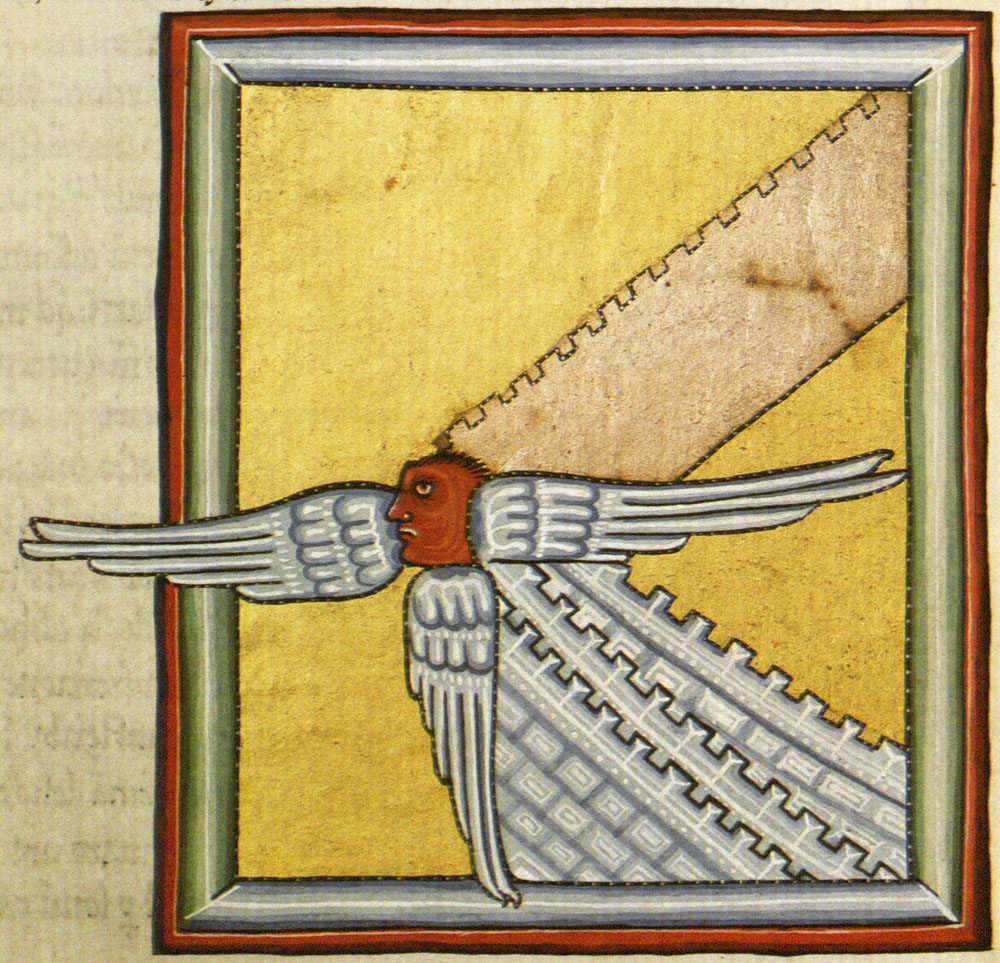
Sapientia is the female virtue of Wisdom, God’s great ornament and coworker in creation. She counsels in the formation of all the creatures made in heaven and earth, she loves, protects, and guides them to the end of time. Hildegard writes about Sapientia’s appearance:
“On top of this dome you see a very beautiful figure standing. She is looking at the people in the world. Her head shines like lightning, with so much brilliance that you cannot look directly at it. Her hands are laid reverently on her breasts. She has on her head a circlet like a crown, which shines with great splendor. And she is clad in a gold tunic; it has a stripe from the breast to the feet, ornamented with precious gems that glitter in green, white, red, and brilliant sky-blue.”
Scivias, Vision 9:25
The imagery (see illustration above) of the three wings reflects the Holy Trinity.The first wing, soaring in the heavens, mirrors the transcendent nature of the Father, representing divine wisdom from above. The second wing, resting on earth as the Incarnate Son, signifies the divine wisdom manifested in human form, grounding spirituality in the earthly experience. The third wing, extending everywhere, symbolizes the immanent and omnipresent life force of the Holy Spirit, connecting all things in a divine harmony.

.
.
Karitas
Karitas, the allegory of Divine Love, refers to the love that flows in the triune God and co-incarnates in every form of life, enabling human’s to participate in God’s maternal love. She is the most important in her writings and has the longest speech. She wears the sapphire blue that is associated with the Word of God. With Karitas, God loved so much humanity that he sent his Son to take a human body.
“I am the supreme and fiery force who kindled every living spark, and I breathed forth no deadly thing […] And I am the fiery life of the essence of God: I flame above the beauty of the fields; I shine in the waters; I burn in the sun, the moon, and the stars”
Liber Divinorum Operum, PL 197, 743b
Karitas also mentions the love for ourselves, the love for our neighbor, and our joy coming from sharing their joy. Only by co-existing in harmony with humans and nature, Death is rejected and perfection of life is attained.

.
.
Viriditas
Viriditas literally means Greenness and symbolizes nature and the principle of life. According to Hildegard, the elements of nature reflect the power of God, and we can receive profound Wisdom from them and experience the ecstatic state of creation by our three parts: the soul, the body, and the senses. The study of nature is an exploration of divine mysteries, and the natural world becomes a sacred realm that humans can experience.
As the force of life, Viriditas was first mentioned in the 4th Vision of Scivias, depicting the conception and growth of an infant in its mother’s womb: “And behold! By the secret design of the Supernal Creator that form moves with vital motion; for, by God’s secret and hidden command and will, fitly and rightly at the divinely appointed time the infant ni the maternal womb receives a spirit, and shows by the movements of its body that it lives, just as the earth opens and brings forth the flowers of its use when the dew falls on it. […] for ti gives vitality to the marrow and veins and members of the whole body, as the tree from its root gives sap and greenness ot al the branches.”
“O most noble viridity,
O nobilissima Viriditas, D 165r-v, R 471rb-va
you who are rooted in the sun, and who in candid serenity shine within a wheel which no earthly excellence comprehends:
You are encircled by the embraces of divine ministries.
You blush like the dawn and burn like the flame of the sun”
Hildegard von Bingen’s writings are significant for their pioneering contributions to various scientific fields, offering also a rare glimpse into medieval intellectual life from a woman’s perspective. The musical journey of our album Viriditas is inspired by these three divine virtues and amplifies a holistic perception of life, emphasizing the interconnectedness of everything. Wisdom, Greenness, and Divine Love are incarnated in every form of life. Music serves as a medium that translates natural and human states and as a reminder that this holistic understanding is not merely a philosophical concept but a lived reality capable of shaping the human experience.
.

.
.
Bibliography
Hart, C., Bishop, J., Newman, B., & Walker Bynum, C. (1990). Hildegard von Bingen: Scivias. Paulist Press.
Hozeski, B. (1985). Hildegard Von Bingen’s Mystical Visions. Inner Traditions/Bear.
Newman, B. (1998). Hildegard von Bingen: Symphonia (2ns ed.). Cornell University Press.
Fierro, N. (1994). Hildegard of Bingen and her vision of the feminine. Sheed & Ward.
 Sibil•la Ensemble
Leave a comment